Deviated Nasal Septum - Causes, Types, Clinical Features & Treatment
💎 Buy my Premium ENT Notes
Instant access to 270+ high-yield ENT notes, plus updates during your access period.
🇮🇳 For Indian Students
· To buy all my notes, click here💡 This post is a free outline of my YouTube video. Get my full handwritten notes using the links above.
Deviated Nasal Septum (DNS)
Definition of Deviated Nasal Septum
Deviated Nasal Septum (DNS) is a condition in which the nasal septum deviates from the midline, resulting in unequal division of the nasal cavity.
Normally, the septum divides the nasal cavity into two approximately equal chambers.
In DNS, one nasal cavity becomes narrower at the expense of the opposite side.
- DNS can occur at any age.
- More common in males.
- Most common cause of nasal obstruction.
- Mild septal deviations are common in the general population.
Etiology of Deviated Nasal Septum
1- Trauma (Most Important Cause)
Trauma is the commonest cause of DNS.
What effects are seen as a result of lateral blow to nose VS Frontal Crushing Injury?
Birth Trauma can occur due to:
- Difficult labor
- Forceps delivery
Compression of the nose during birth may produce septal deformity that becomes apparent later in life.
2- Developmental Errors
The nasal septum develops from the Tectoseptal process which descends to fuse with the developing palate.
Abnormal growth between Palate & Base of skull may result in septal buckling and deviation.
DNS is commonly associated with:
- Cleft lip
- Cleft palate
- Dental abnormalities
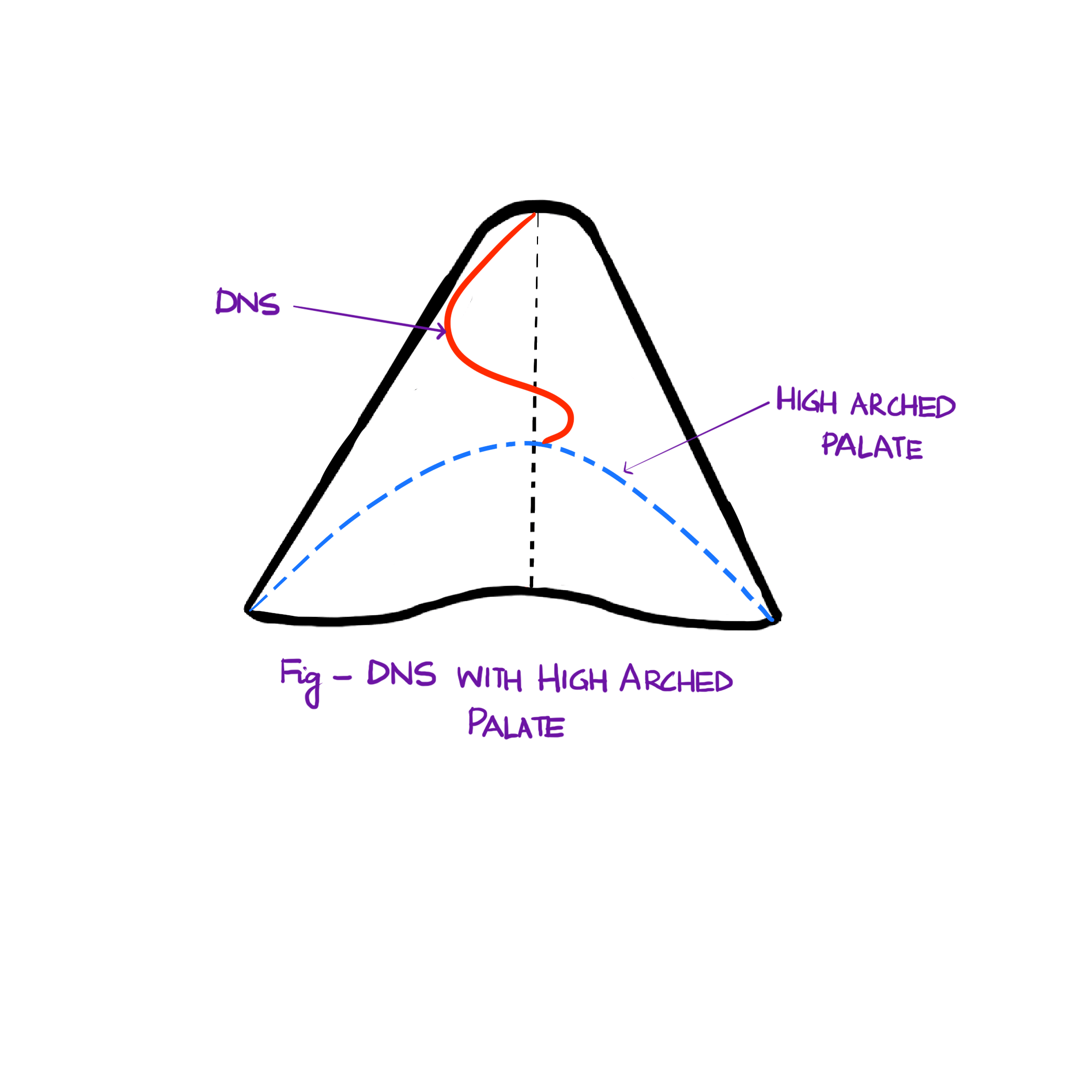
3- High Arched Palate
Commonly seen in:
- Chronic mouth breathers
- Children with adenoid hypertrophy
What are the features of Adenoid facies?
How does a high arched palate lead to deviated nasal septum?
4- Nasal Masses
Any expanding intranasal lesion may push the septum toward the opposite side.
Examples:
- Juvenile Nasopharyngeal Angiofibroma
- Rhinosporidiosis
- Inverted Papilloma
- Nasal Polyps
5- Racial Factors
DNS is reported more frequently in Caucasian populations.
6- Hereditary Factors
A familial tendency has been observed in some patients.
Classification of Deviated Nasal Septum
DNS can be classified in three ways:
- Anatomical Classification
- Morphological Classification
- Cottle's Classification
1️⃣ Anatomical Classification
Depending on the structures involved:
1- Cartilaginous DNS
Only septal cartilage involved.
2- Bony DNS
Only bony septum involved.
3- Mixed DNS
Both cartilage and bone are involved.
2️⃣ Morphological Classification
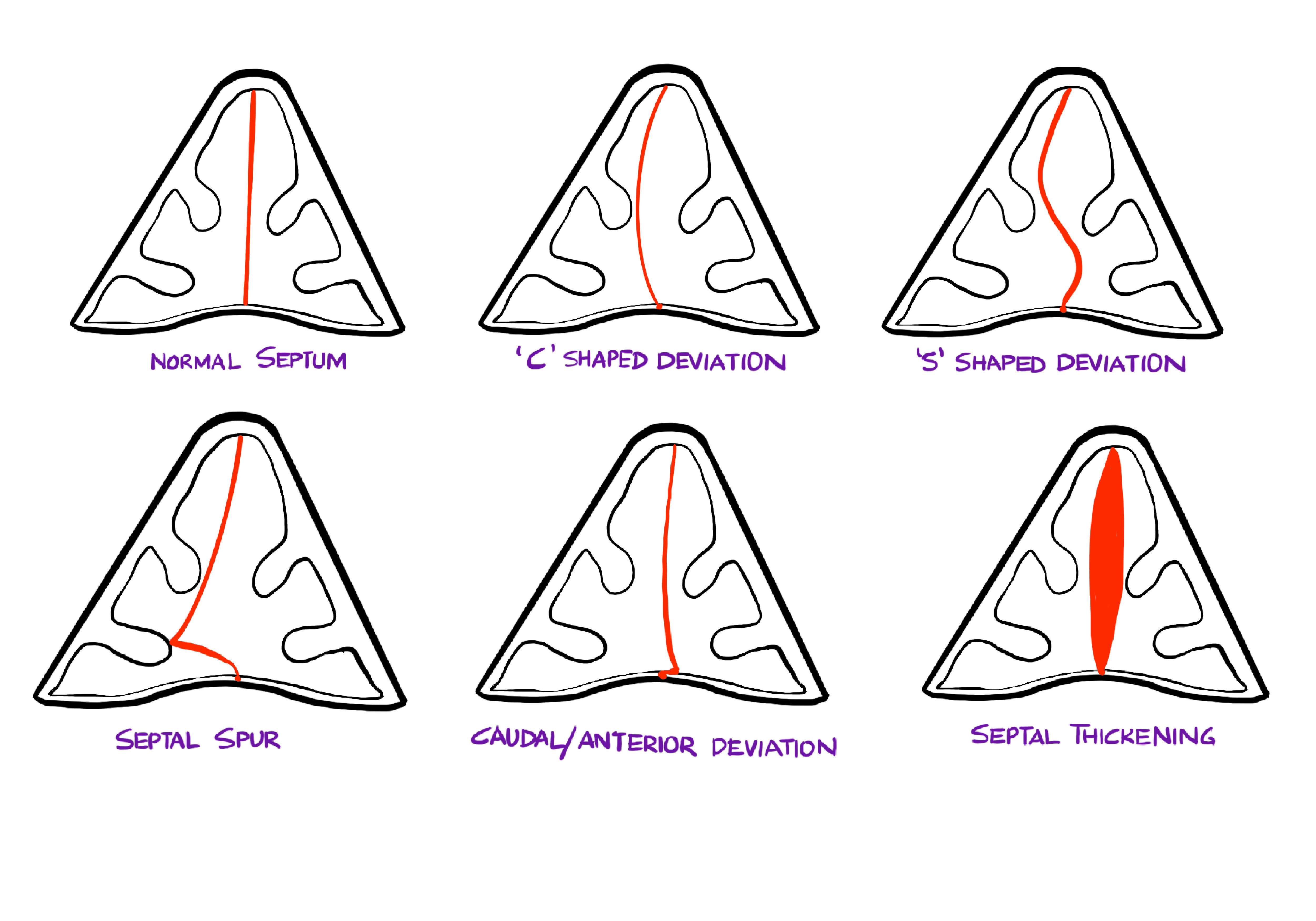
1- C-Shaped Deviation
The septum deviates to one side in a C-shaped manner.
Clinical Significance
- Narrowing of one nasal cavity
- Widening of the opposite side
- Compensatory Turbinate Hypertrophy
Why does Compensatory Turbinate Hypertrophy happen in C shaped DNS?
2- S-Shaped Deviation
Deviation occurs on both sides.
May occur in Vertical plane or Anteroposterior plane.
Produces Bilateral nasal obstruction
3- Caudal (Anterior) Dislocation
The caudal end of the septal cartilage becomes displaced from Maxillary crest & Anterior nasal spine.
What type of nasal obstruction seen in Caudal septal dislocation?
4- Septal Spur
A septal spur is a sharp shelf-like bony projection arising from the osteocartilaginous junction of the nasal septum and projecting laterally into the nasal cavity.
What is the most common site of septal spur?
What symptoms can be seen due to septal spur?
5- Septal Thickening
May occur due to:
- Organized septal hematoma
- Overriding fractured septal fragments
3️⃣ Cottle's Classification
1- Simple DNS
- Mild deviation
- No nasal obstruction
- No treatment required
2- Obstructed DNS
- Severe deviation
- May touch lateral wall
- However, after vasoconstrictor application - Turbinates shrink
Treatment
- Medical therapy
- Decongestants
- Sometimes surgery
3- Impacted DNS
- Marked septal angulation
- Spur present
- Septum in contact with lateral wall
- No improvement after vasoconstrictor application.
Treatment
Surgical correction required
Clinical Features of Deviated Nasal Septum
Clinical features can be divided into:
- Symptoms
- Signs
Symptoms of Deviated Nasal Septum
1- Nasal Obstruction
⭐ Most common symptom of Deviated Nasal Septum
The obstruction may be:
- Unilateral
- Bilateral
depending upon the type of septal deviation.
What are the causes of Bilateral nasal obstruction in a case of Deviated Nasal septum?
What is Paradoxical Nasal Obstruction? Why Does It Occur?
2- Headache
Headache may occur due to the following reasons:
-
A septal spur may press against the lateral wall and middle turbinate leading to Sluder's Neuralgia.
-
Sinusitis
-
Vacuum Headache
What is Sluder's Neuralgia? Which nerve gets compressed here? What are the symptoms of Sluder's Neuralgia?
What is the pathophysiology behind sinusitis in Deviated Nasal Septum ?
What is Vacuum headache?
3- Sinusitis
Deviated Nasal Septum may obstruct sinus ostia.
This causes Poor drainage & Poor ventilation leading to recurrent rhinosinusitis.
4- Epistaxis
Occurs due to two mechanisms:
-
Septal Spur
-
Dry Air Currents - The convex side of the septum is exposed to excessive drying.
This causes crusting, mucosal injury and recurrent bleeding.
How does septal spur cause Epistaxis?
5- Smell Disturbances
Severe Deviated Nasal Septum may prevent inspired air from reaching the olfactory region leading to hyposmia and anosmia.
What is Hyposmia?
what is Anosmia?
6- External Nasal Deformity
Deviated Nasal Septum may be associated with:
- Deviated nasal dorsum
- Tip deformity
- Columellar deviation
due to involvement of cartilaginous and bony framework.
7- Middle Ear Infection
Deviated Nasal SeptumS may contribute to:
- Eustachian tube dysfunction
- Poor middle ear ventilation
predisposing to Recurrent Otitis Media
Signs of Deviated Nasal Septum
1- External Examination
Look for:
- Deviation of external nose
- Dorsal deformity
- Tip deformity
- Columellar deviation
2- Anterior Rhinoscopy
- Look for Septal Abnormalities
- C-shaped deviation
- S-shaped deviation
- Caudal dislocation
- Septal spur
- Septal thickening
-
Check for Compensatory hypertrophy on opposite side
-
Look for congestion, crusting and dryness in Nasal Mucosa
-
Nasal Discharge
What does presence of nasal discharge in a case of Deviated nasal septum indicate?
3- Re-examination After Vasoconstrictor
Important to differentiate:
- Obstructed DNS
- Impacted DNS
Improvement after vasoconstrictor suggests turbinate contribution to obstruction.
4- Functional Tests of Nose
Cold Spatula Test - Reduced fogging on affected side
Cotton Wool Test - Reduced movement of cotton on affected side
What is Cottle's test? What does a positive Cottle's test indicate?
Investigations of Deviated Nasal Septum
Most cases require no special investigations.
1- X-ray PNS
Previously used for evaluation of associated sinusitis.
2- CT Scan of PNS
Current investigation of choice when:
- Rhinosinusitis is suspected
- Surgery is planned
What are the things seen in CT PNS in a case of Deviated Nasal Septum?
Treatment of Deviated Nasal Septum
Asymptomatic Deviated Nasal Septum
- No treatment required
Many individuals have mild septal deviations without symptoms.
What are the Indications for treatment in a case of Deviated Nasal Septum ?
Symptomatic Deviated Nasal Septum - Surgical Treatment
Two surgical procedures are described:
1- Submucous Resection (SMR)
- Bilateral mucoperichondrial flap elevation
- Extensive removal of septal cartilage
Status ❌ Largely obsolete
Why is SMR not preferred nowadays?
- Radical procedure
- Removes excessive septal support
2- Septoplasty (Treatment of Choice)
⭐ Current gold standard surgery for Deviated Nasal Septum
- Conservative surgery
- Removes only deviated portions
- Preserves septal support
What are the advantages of Septoplasty over SMR?
What are the differences between SMR and Septoplasty?
Complications of Untreated Deviated Nasal Septum
- Habitual Mouth Breathing
- Chronic Rhinosinusitis
- Atrophic Rhinitis
- Asthma
🧠 Viva Pearls
- Most common cause of DNS → Trauma
- Most common symptom of DNS → Nasal obstruction
- Most common cause of nasal obstruction → DNS
- Septal spur arises from osteocartilaginous junction
- Common site of septal spur → Junction of vomer and septal cartilage
- High-arched palate predisposes to DNS
- DNS is commonly associated with adenoid facies
- Impacted DNS requires surgical treatment
- DNS is the most common cause of nasal obstruction.
- Nasal obstruction is the most common presenting symptom.
- Bilateral obstruction occurs in S-shaped DNS and C-shaped DNS with compensatory turbinate hypertrophy.
- Septal spur may cause Sluder's neuralgia.
- Obstruction of osteomeatal complex predisposes to sinusitis.
- Cottle's test evaluates nasal valve obstruction.
- CT PNS is preferred before surgery.
- Septoplasty is the treatment of choice.
- SMR is largely obsolete.
- Untreated DNS may lead to chronic rhinosinusitis, mouth breathing and atrophic rhinitis.
📝 All topics and questions from this post are explained in detail in my Premium ENT Notes, which are designed for clinical understanding and exam success.
Residency is hard enough. Studying for it shouldn't be 😊
💎 Buy my Premium ENT Notes
Instant access to 270+ high-yield ENT notes, plus updates during your access period.
🇮🇳 For Indian Students
· To buy all my notes, click here